
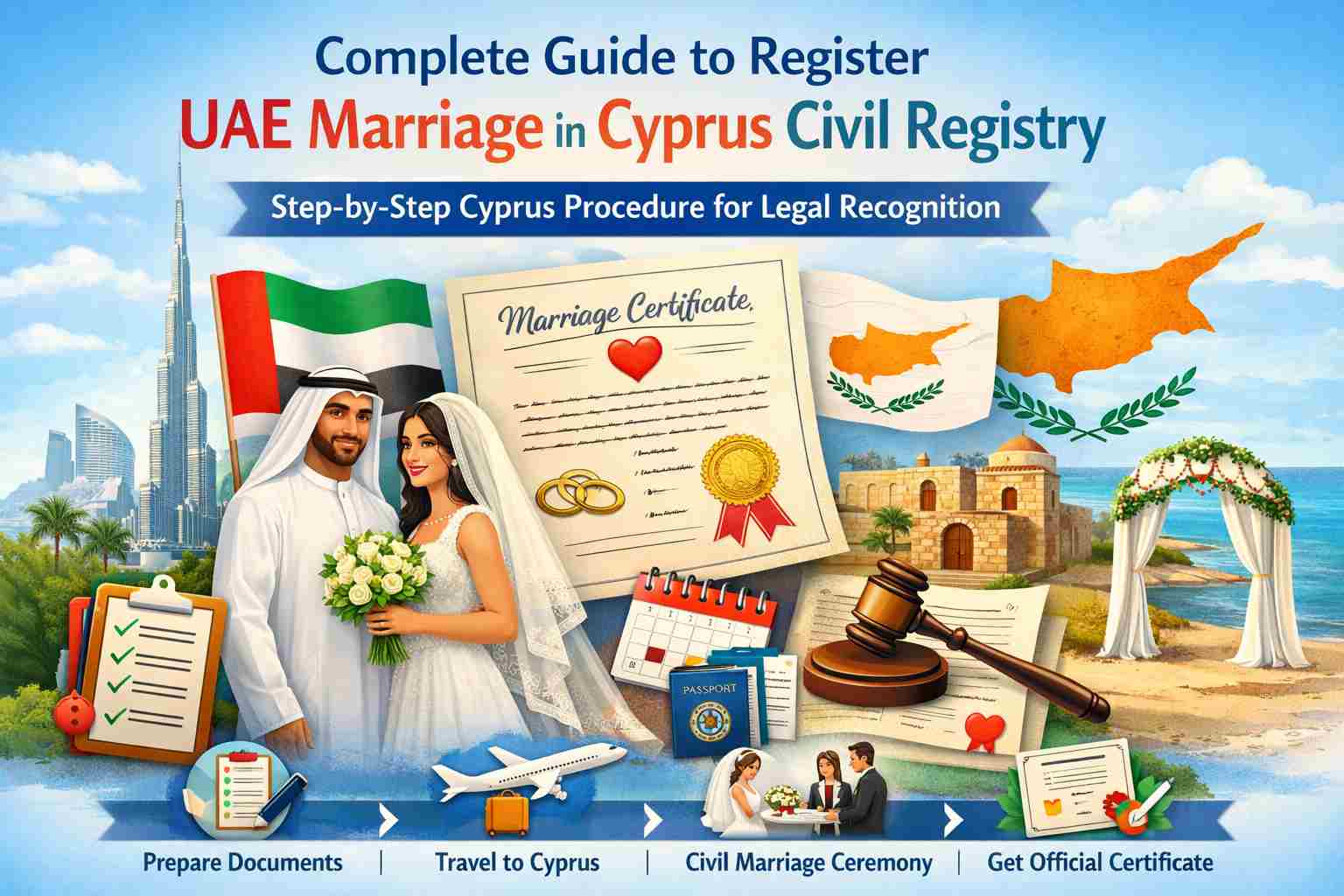
Marrying abroad is a beautiful milestone — but ensuring that your union is legally recognised in the country where you plan to live or settle is equally important. For couples who married in the United Arab Emirates (UAE) and now want to register their marriage in Cyprus, understanding the Civil Registry procedure is essential for legal validity, residency applications, inheritance rights, and other official matters.
This comprehensive article breaks down everything you need to know about how to register your UAE marriage in the Cyprus Civil Registry, including required documents, step‑by‑step procedures, common challenges, and tips to make the process smooth and successful.
Introduction: Why Register Your UAE Marriage in Cyprus
If you and your spouse married in the UAE but intend to live, work, study, or settle in Cyprus, officially registering your marriage with the Cyprus Civil Registry and Migration Department ensures your marital status is formally recognised under Cyprus law — and often beyond, within the European Union (EU) framework.
A foreign marriage that isn’t registered might not be accepted during residency applications, passport procedures, spousal benefits, inheritance, or even banking matters. Registration guarantees that your marriage is valid, official, and usable for all government and legal processes in Cyprus and, in many cases, accepted internationally.
Recognition isn’t automatic just because you married elsewhere — you must follow a legal procedure. In Cyprus, this involves verifying your documents, having them translated, and ensuring proper attestation so that authorities can accept your UAE marriage certificate and register it accordingly.
Who Can Register a UAE Marriage in Cyprus?
Eligibility Criteria
Almost any couple married abroad, including in the UAE, can register their marriage in Cyprus — provided the marriage meets legal standards in both the UAE and Cyprus.
Here’s who can apply:
- Both spouses legally married under UAE law.
- Couples who are Cypriot citizens, foreign nationals, or mixed nationality couples.
- Residency status doesn’t necessarily prevent registration — both residents and non‑residents can register their marriages.
However, Cyprus does not recognise polygamous marriages — only one spouse (first wife) is treated as spouse under Cypriot law.
Residency vs. Non‑Residency
If you reside in Cyprus on any visa category (work, study, family, etc.), registration is usually done locally through the Civil Registry and Migration Department or district offices. Non‑residents can often register by submitting documents through embassies or consulates of Cyprus in their country.
This flexibility ensures that couples who cannot immediately travel to Cyprus can still begin the process and submit necessary paperwork from abroad.
Why Register Your UAE Marriage in Cyprus
Registering your UAE marriage in Cyprus offers many important legal and practical advantages:
1. Legal Recognition in Cyprus and the EU
Once your marriage is registered, it’s legally recognised under Cyprus law and by extension in the EU. This recognition makes it easier to enforce spousal rights, inheritance claims, property claims, and family‑related legal matters within Cyprus and often in other EU states.
2. Residency and Immigration Benefits
Foreign spouses often need proof of marriage to apply for:
- Residency permits
- Family reunification visas
- Work permits
- Permanent residency
Without a registered marriage certificate recognised locally, authorities might decline or delay immigration paperwork.
3. Financial and Legal Affairs
With a registered marriage certificate, spouses can:
- Open joint bank accounts
- Be listed as next of kin
- File for tax and social benefits
- Have rights in inheritance and succession matters
The registered relationship provides peace of mind and legal backing for essential life decisions.
Required Documents for Marriage Registration in Cyprus
Proper documentation is the backbone of the registration process. Cyprus authorities are strict — incomplete or improperly attested papers can delay the entire process.
Here’s what you’ll need:
1. Original UAE Marriage Certificate
Your official marriage certificate issued by the UAE authority where you married is absolutely necessary — photocopies won’t be accepted.
2. Certified Translation
If your marriage certificate is not in English or Greek, it must be officially translated into one of these languages by a recognised translator.
Cyprus authorities require translations for all documents submitted for registration.
3. Apostille or Legalization
For foreign documents to be accepted in Cyprus:
- If your country (like UAE if a Hague Convention member) has signed the 1961 Hague Apostille Convention, your document must have an apostille stamp to be recognised.
- If not, the certificate must be legalised by the UAE Ministry of Foreign Affairs and the Cyprus Embassy or Consulate.
This step verifies the authenticity of your UAE marriage certificate and makes it valid for Cyprus authorities.
4. Identification Documents
Both spouses must provide valid passports or national ID cards.
5. Proof of Civil Status
Documents like:
- Certificate of no previous marriage
- Divorce decree (if previously married)
- Death certificate of a former spouse (if widowed)
may be required, depending on your situation.
6. Additional Supporting Documents
Authorities might request further documents based on nationality or specific cases — for example, proof of residency or a migration permit if you’re applying for immigration advantages.
Step‑by‑Step Procedure to Register UAE Marriage in Cyprus Civil Registry
Below is a clear, practical timeline of what you’ll need to do to get your marriage registered.
H3: Step 1 — Prepare All Required Documents
Collect all original documents listed above.
✔ Make sure translations are certified.
✔ Ensure apostille/legalisation is done correctly.
Starting this well in advance will prevent costly delays.
H3: Step 2 — Visit the Civil Registry Office
Depending on your location:
- If you’re in Cyprus, visit a Civil Registry and Migration Department office or District Registry office.
- If you cannot travel, contact a Cyprus Embassy/Consulate that handles Civil Registry documentation.
Bring all originals and copies for verification.
H3: Step 3 — Document Verification and Legalization Check
Officials will examine:
- Authenticity of all submitted documents
- Proper apostille or embassy legalisation
- Translation accuracy and completeness
Confirm with authorities whether extra certifications or notarial affidavits are needed.
H3: Step 4 — Complete Marriage Registration Form
Once the documents are accepted, you’ll fill out the official marriage registration form.
This form captures:
- Spouse details (names, passport numbers, dates of birth)
- Date and place of marriage (UAE)
- Translators’ and attestor information
H3: Step 5 — Pay Registration Fees
Fees vary depending on the service provided. Generally, there are:
- Processing fees
- Translation/legalisation fees
- Issuance fee for the new Cyprus marriage certificate
Always ask the Civil Registry office for the current schedule because fees may change.
H3: Step 6 — Receive Your Cyprus Marriage Certificate
Once your application is processed and approved, the authorities will issue a Cyprus marriage certificate.
This is officially recognised and can be used in government, banking, immigration, and legal matters.
Legalization and Attestation of UAE Marriage Certificate
Apostille vs. Legalization
Whether you need an apostille or full legalisation depends on whether the document’s issuing country (like UAE) is part of the Hague Apostille Convention.
- Apostille: Simplified authentication used when both countries are members.
- Legalisation: Involves validation by the issuing country’s Ministry of Foreign Affairs and then by the embassy/consulate of the country where you’ll register (Cyprus).
Translation Requirements
Documents must be translated into Greek or English. Even if a translation exists from your home country, Cyprus may require additional certification if not done by an approved translator.
Common Challenges and Pitfalls to Avoid
Registration seems straightforward but can become complicated without preparation. Here are common roadblocks:
1. Incomplete or Incorrect Documentation
Missing apostille stamps, unverified translations, or mismatched personal data can delay approval.
✔ Double‑check spelling of names, passport numbers, and dates.
2. Translation Errors
Translations must be done professionally and certified. Amateur or incomplete translations can result in application rejection.
3. Attestation Delays
Attestation through foreign ministries and embassy consular services can take weeks — plan well ahead.
4. Legal Differences
Some documents accepted in the UAE may not meet Cypriot standards unless properly signed, apostilled, and translated.
Benefits of Registering Your UAE Marriage in Cyprus
Here are the key long‑term advantages:
Legal Recognition and EU Framework
A registered marriage holds legal weight in Cyprus and often in other EU countries, which is crucial for international mobility.
Simplified Immigration Procedures
Registered marriages help with residency, visas, and family reunification processes.
Spousal Rights and Benefits
Couples can access:
✔ Inheritance rights
✔ Health insurance benefits
✔ Spousal tax benefits
✔ Banking and property rights
International Recognition
Once registered, your marriage becomes a formal legal record useful in many international and domestic procedures.
Tips for a Smooth and Quick Registration Process
Follow these tips to avoid hassles:
1. Start Early
Apostille and translations can take time — don’t wait until the last minute.
2. Translate All Documents Professionally
Ensure translations are from certified translators recognised by Cyprus authorities.
3. Double‑Check Legalisation Requirements
Some papers require more than one level of authentication — check early.
4. Keep Multiple Copies
Keep certified copies for your records and for use when filing immigration or residency applications.
5. Consult Professionals If Needed
A lawyer specialising in foreign marriage registrations can streamline the process and prevent mistakes.
Frequently Asked Questions (FAQs)
Can Non‑Residents Register Their UAE Marriage in Cyprus?
Yes. Non‑residents can submit documents through Cyprus embassies or consulates or register directly if they can travel.
How Long Does the Process Take?
The timeline can range from a few weeks to several months, depending on document verification, legalisation, and office workload.
Is Translation Mandatory?
Yes — all documents must be officially translated into English or Greek.
Can I Register Without Apostille?
Only if documents have alternative legalisation accepted by Cyprus authorities; otherwise, apostille is usually required.
Can I Get a Digital Marriage Certificate?
Some civil registry offices may provide digital copies, but policies vary — check with your local office.
Conclusion
Registering your UAE marriage in the Cyprus Civil Registry is a crucial step if you’re planning for residency, legal recognition, inheritance rights, or international validation of your marriage. The procedure, while detailed, becomes straightforward with preparation, correct documentation, and a clear step‑by‑step approach.
By following the guidance in this article — from collecting required documents and ensuring legalisation to submitting your forms and receiving your official Cyprus marriage certificate — you’ll be well on your way to getting your marriage recognised under Cyprus law.
Be proactive, allow time for translation and legalisation, and consult local authorities whenever in doubt. With proper preparation, registering your UAE marriage in Cyprus can be smooth, efficient, and stress‑free.
ALSO READ: Rox.com Products Catalog: Complete Guide to Fashion, Electronics, Home, Beauty & Luxury Jewelry